Collections
Item
George Polley's life story (Chapter five)
Object type
Date
1918-2015
Description
George Polley’s life history, read by George Polley. Chapter five (4137a), 1935
Highlights in this oral history recording include:
0.00 Jubilee celebrations
1.00 Bringing home 2 non moving tractors from west of London takes a week
15.00 Went to Aldershot tattoo
15.30 Purchase of ex-army horse Jacko
17.10 washing out traction engine boilers
18.50 1936 Double family wedding, third sister marries a bit later
21.00 Marks Tey Hall Farm Barn Fire
21.55 Affected by lightning when riding a bike
22.30 Join tour of WW1 battlefields
25.50 Miscellaneous – pieces of Wigborough Zeppelin in workshop
27.20 Sunday school teacher Miss Allan, daughter of Dobbies manager
28.30 Father knocked off on bike by lorry that fails to stop
People
Interviewee
George Polley
Place
School Road, Copford
Date
c1999
Transcribed
2026
By
Trevor Leung using AI, corrected by Andrew Waters and Celia Dodd
Transcript
GP tarting up now on page five, I think we've got round to round about the 1935 era. That would be the Year of the Jubilee celebrations. I remember we had the Union Jack flying on the flag pole at Ellesmere and the local celebrations were in the Village Hall, grounds - and that, I don't remember too much about it. It was just one of those things that pass through time.
The main thing, I think, that happened in 1935, my father and uncle went to Staines, Sunbury Common actually, Middlesex and bought two second hand Saunderson tractors on a farm there. They were both none runners, so that meant we'd got to get them home somehow. The lorries of that time would've meant they could only come one at a time. So, as it was reasonably our slack time of the year, Father decided if we took the one Saunderson that we did own, run that down, we could tow the other two back from Sunbury Common to Marks Tey. That was decided on and as starters my uncle was gonna drive the live tractor.
I went on my bicycle in front of him to find the way. We got as far as Hatfield in Hertfordshire the first day, and of course at that time, the De Haviland airfield, the Comet and all that sort of thing, there wasn't a bed to be had in the place. So to get undercover, we'd pulled the tractor into a pub yard and there was a lorry in there. So we kipped up in the back of that, my uncle and me. The second day with me piloting the way on bike, we made Sunbury Common in the, on the Tuesday afternoon. That night, the rest of the afternoon, and that we had, more or less organised things. We'd got two rigid tow bars that we were gonna couple these other two tractors up with.
And decided that I was to steer the one in the middle and father on the one at the back. Having decided that, it was time to get a bit of rest. There again, there was a comfortable hay loft over the top of the dairy, so that's where we made our bed, in amongst some hay, up above the cow shed. And of course, during the night there was the rattle of the chains as the cows were tethered in, and, the occasional moo and the noise of nature that was going on. But we got some sleep.
Wednesday morning, got everything lined up. My bicycle went on top of my tractor that I was gonna be on. But unfortunately, we had to take the driving pins out of the wheel because somehow or another, the reverse gear and the forward gears in the gearbox were inter-meshing, and we couldn't tow until we got the driving pins out. That was overcome. But of course that meant I'd got no brakes on mine. But then, between the two, well, we thought that was reasonably safe. So we, we set off. And we got as far as Northwood on the Wednesday, on the return journey. There again, we slept in a farm shed.
The Thursday, we managed to get about three miles this side of Hatfield and pulled in a farmyard there. And there was what was known as a chantry. It was a converted chapel and with a few bags of this and a bag of that and a bit of straw, we sort of like kipped up the three of us, males(?) wise and that sort of thing. We was like pulling up at a local shop and getting a loaf of bread and a bit of margarine or something like that so that was keeping us going. Perhaps if there was a transport cafe handy, we would pull in, get a cuppa, but it was a case of make do.
That was on the Thursday. On the Friday, we got as far as Takeley, got held up a bit in Bishops Stortford because when we came to the crossroads coming through from the Hadhams, I mean in those days there was no such thing as bypasses, and we got to the main crossroads in Stortford, we had got to do a sharp left-hand turn and downhill. So of course, the leading tractor that was towing us was okay, he came round. I came round, but Father was on behind and somebody coming the other direction cut him a bit by him, so he had to lock short, which put his front wheel under the drawbar that was towing him. Consequence was he couldn't get it jammed under the bar and he mounted the narrow pavement and there was a stone step outside what was a butcher’s shop forming the corner, and of course he took the chip out of the stone step. We managed to straighten things out and got to the bottom of the slope in a wide bit of the road. And, father and uncle went back, by this time the police had arrived, but me being underage for and having no driving licence, I kept with the tractors and hoped that I wouldn't be called for evidence. But anyway, things went off alright and the butcher chappie in the shop didn't make any complaint apart from the little chip out the corner of his step. And the last time I was through Bishops Stortford I see the step was still the same. But the policeman he went about his business and we never heard anymore about it. We got organised again and started off and climbing up out of this side of Bishops Stortford, I think it was the crossroads at the top of the hill, that would be the crossroads between the A120, I suppose that would be, and what I think was the A11 in those days, and there was traffic lights at the top. Just as we were getting to the top the lights went red.
We, if we'd have stopped, we wouldn't have got going again because the tractors in those days weren't that great. And, clutch-wise, brake-wise, I'm talking about brakes, the two dead tractors were useless from the brake’s point of view anyway. If we'd have had them, we'd have had to let them off all at the same time to get moving again.
I think my uncle had got his front wheels of his tractor slip more or less across the line, shall we say, at the lights when they changed. So he kept, he took the decision, he kept going. Luckily for us, there was a truck, a lorry on both sides. Even though they'd got right of way, they stood there. And I remember seeing the look on their faces, one broad grin from ear to ear, as we went struggling across the crossroads. Rather scary, but we survived. And we arrived at Takeley that night by dusk and it was a case of getting off the road somewhere. There was a baker's shop, had got a yard at the side of it, on the northern side of the road, it’s at the top end of the street, and, we had permission, we pulled in there for the night. Father decided that, we'd had enough so we, at that time, the trains were still running from Bishops Stortford to Braintree, and we just managed to get the train at Takeley. Father took tickets through to Witham, but when we got to Braintree, the train didn't go any further.
And this was half past nine, 10 o'clock at night. But when the booking clerk, station master, whatever he was, knew of our plight, he got in touch with the bus station. It was Moore's bus at that time, there was Moore's and Hicks, another bus firm on that route from Braintree to Colchester. As luck had it, the last one of Moore’s was just about to leave the bus station, but they held there until we were able to scramble around and get onto the bus, which brought us to Marks Tey. That was the first night we had our own bed to sleep in and, oh boy, was that comfortable! The Saturday, we went back to Takeley, I think we must have got the bus right through.
And we got as far as Braintree, that was a short haul then. Father and uncle came home on the bus. I decided I would bike home so that I'd got my bike with me. It had been left on the tractor all the rest of the time, and, we didn’t get them, the tractors home until the following Monday, early afternoon, it was quite an experience. Whether it was a wise one or unwise is left to history. I know one thing, I'd got a sore behind. The tractors had iron wheels, like the old traction engine type of wheels and it wasn't actually a comfortable ride, but that was an experience and we made it. And I remember coming down one hill, I got a call from behind, father called out. "Rub the kerb, boy. That will act like a brake." So of course, I drove mine so that I was right tight on the kerb and on that left hand hind wheel were two lace loose strakes, and every time they hit the kerb, it was like a church bell ringing out, that always stuck in my mind. And, uh, but that was how we'd done things in those days.
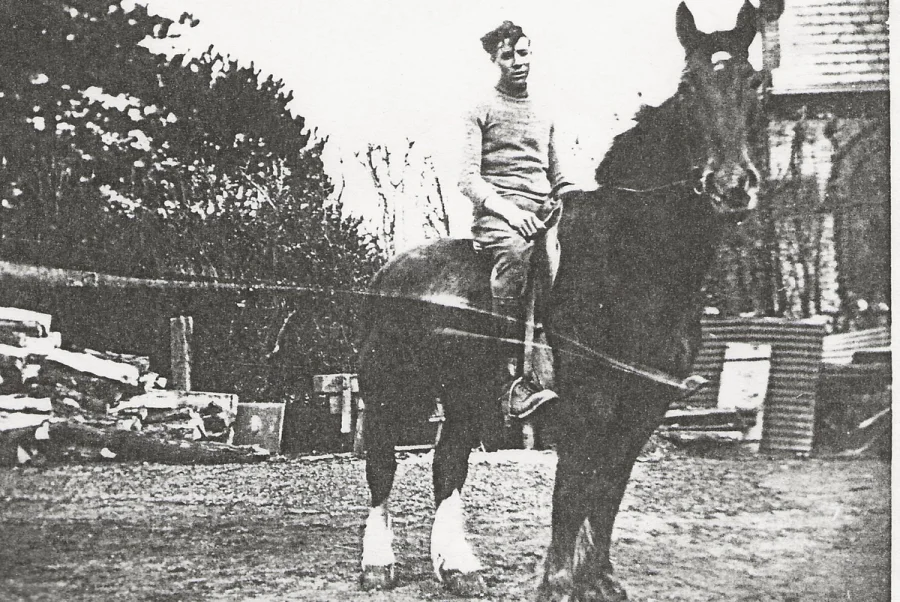
I think later or middle of that year, there was a local party from Colchester were going to the Aldershot Tattoo. And father, mother and myself, we joined the party. So we saw the Aldershot Tattoo. That was a great event, that. And then, the old Ford Model T had been scrapped. And there was a horse sale, Colchester Market during that year. The army were disposing of a lot of their horses and there was one, he was an ex-artillery horse, got his tattoo marks on his hoofs and onto his shoulder. And, we bought Jacko, as we named him. We bought him for 13 pounds. The, we brought him home, of course we hadn't got a stable but soon made room for him in the workshop at one end.
Got him so he was bedded down and he had his food and his drink out of buckets to start with, but we found that he was quickly adjusting to circumstances. And, the old Ford Model T as I said, that was scrapped but out of that, the axles, wheels and the back we made into a four-wheeler horse drawn vehicle. That was how we moved a lot of our firewood then on the short journeys. And the rest of that year, I suppose it was bike trips out to various places, Clacton, Chelmsford, all over the place. Just from a relaxation point of view, the dirty side of the jobs was washing out the engines.
They had to be washed out once a fortnight. By that, I mean, the water in the boilers had to be drained out, and we had what was known as a force pump that pumped a strong jet of water through the so-called mud holes. And with the Marshall engine, one of these mud holes was placed, and that's where most of the mud collected that was dried out, well not dried out, but was residue from some of the old pond’s water from the farms. And this particular mud door was halfway across the back of the fire box area, which meant there was only a nine inch space between that and the front of the water tank. So to get at that with the hose and jet of water, one had to lay on one's back under the engine. And of course, you know where the water went, but that was some of the uncomfortable bits, but we're still thriving.
Going on to, the next year, 1936, that was the year when King George the 5th died. And, in our family, we had a double wedding. My oldest sister and my youngest sister married. May, the oldest, married Jack Digby from Hatfield Peveril. Phyllis, my younger sister, she married Dick Jones from Ramsden Heath. They were married in Mark Tey Church and we had the wedding reception in the Village Hall at Aldham.
I remember there was quite a gathering of guests and so father and mother had hired one of the local buses to take the guests from the church to the reception at the Aldham Village hall. That was two of the girls married off - that was at the Easter. At the Whit my second sister Connie she got married in Marks Tey Church a little more quietly. She married Frank Hunt from Marks Tey, that was a little quieter affair, but even so nonetheless sincere. And so of course that was all the girls away. Just little old me left at home with Mum and Dad. There it made a little more space, although, of course the girls only came home at times because they were out in service most of the time in various households.
At Mark Tey Hall, there was a big thatched barn there at the farm. And a local thatcher, Mr. Appleby, he was about halfway through re-thatching it when it caught fire and the whole lot was burnt to the ground. It was really something that, because even though there was a pond handy the fire brigade wasn't so speedy in those days. They did the best they could, but with a timber building and thatch roof, it would take some stopping.
Amongst the works of that time, we had a tractor, Mr. Bird's had somehow got in the ditch. We had the job of winching that out, which was one of many, really in the few years around that time.
I was coming home. I’d been to visit my sister at Billericay, Phyllis and Dick, and this would've been in the June of that year and I was coming down through Rivenhall and there was a terrific thunderstorm and it was the one flash of a lightning. I felt all the use go out of my arms. How I kept on the bike, I don't know, but I managed to get to the transport cafe that was there at the time and I staggered inside and the good lady there behind the counter, she took care of me and she gave me a cup of tea and brought me around a bit because I felt stunned. I think, you know, it must have been a partial strike from this terrific flash of lightning. But that was just one of those things.
During that year, if I remember rightly, there was a local party from Colchester organised to do a tour of the battlefields. And that was in the July 1936. We sailed from Harwich, 11 o'clock at night we left Harwich. Got across to Zeebrugge, and coaches were there and took us round the battlefields and we came back. We got the boat again at 11 o'clock on the, that night and arrived back at half past six in Harwich the next morning. So that would be the 3rd, 4th, and 5th of July.
The battlefields that we visited, and I have photographs of that time, Tyne Cot Cemetery and St. Julian’s Cemetery. That was where the Canadians suffered awful losses from gas and the monument there to them, the soldiers and the horses all around in agonising shapes, suffering from the gas attack as it was portrayed in marble.
And we visited Bruges. And, we had one meal I remember in Hotel Schiendals in Poperinge, that was the outskirts of Ypres if I remember rightly, or Wipers as the soldiers used to call it 'cause there were so many wiped, soldiers wiped out there. So the town was named as or called as Wipers. That that was something I can remember as another happening.
That year I went down to Southend to see the lights and a little later in the year, King Edward abdicated - lots of bits and pieces.
And, I remember, going back now to my school Sunday School days, on one of our Sunday School outings to Walton on the Naze I remember the Graf Zeppelin came along the coastline. And that was the only time that I saw it. It wasn't very high, but we had a beautiful view of it as it went slowly along the coastline. We learned afterwards that it was mapping the beaches.
Talking about the Zeppelins, the Wigborough Zeppelin in the old workshop, in our contract days, there was one or two twisted bits of framework laid in the, on the bench, in one corner of the workshops.
And Sunday school, another thought. My school, Sunday School teacher was a Miss Allen. Her father was the manager at Dobbies Seeds place at Marks Tey. Hence the road getting called Dobbies Lane. It was at Palmers Farm. They were a branch of the Dobbies from Dalkeith in Edinburgh, Scotland, famous for rose growing in Scotland, famous in Essex for their sweet peas. And Mr Allen and his wife came down from Edinburgh to manage the Marks Tey site. That site now is Bypass Nurseries owned. But, there again, we used to do quite a bit of work for Dobbies in the way of various seeds, thrashing and so forth.
Around about this time, father and I, we'd been thrashing out in the Layer Marney area and the end of the day we were coming cycling home through what was known as Blind Lane. That was a road, that was closed off when the Birch airfield was built, but halfway through this, it was a very narrow road, and halfway through was a fairly acute S bend, and as we were coming up towards this bend we could hear a lorry or something coming from the opposite direction. So we'd been riding side by side but I pulled back in behind father and we kept close in the side, but all of a sudden, a lorry came around the corner of this S bend and he was travelling fast. So he didn't actually damage Dad to any great extent, but caught his arm and his handlebar, so it tipped him off his bike.
And, the lorry kept going. Didn't attempt to stop. Luckily I managed to catch the name on the back of the lorry - Evers, Tiptree, so we knew it was one of the builders at that time, one of their lorries. Father got in touch with the police and it was traced up that the driver was a Mr Butterworth and he was charged with dangerous driving.
And because there were marks on the road that clearly showed what had been going on, and he was taken to court. And unfortunately for him, even though it was his own fault, he lost his licence for five years, which rather upset things and,[This incident was also recorded for 1938]
Credit
© Marks Tey Archive
Usage
CC-4.0, view usage statement
Provenance
Polley family
Archive code
MTHP.7.20.1.5