Collections
Item
George Polley's life story (Chapter four)
Object type
Date
1918-2015
Description
George Polley’s life history, read by George Polley. Chapter four (4136b)
Highlights in this oral history recording include:
0.00 Well digging
1.10 First bicycle c 1930
3.50 1933 – primrose picking in ditches, cycling trips
5.50 Circus elephants walked from Chelmsford to Colchester, Various trips and outings
Haystack Fire Kemps Farm Stanway
14.20 Church choir outings Yarmouth, Sunday School to Walton
Made plan for Rector of the allotments
Made Weathervane for Canon Steele of a trout paid 5s
20,00 Joined Youth Guild at Methodist Church – Wednesday evenings
20.40 Purchase of Sanderson tractor, scrapping of traction engine. Scrap merchant worker Freddie Wilson delivered Sunday papers from a pony and trap
People
Interviewee
George Polley
Place
School Road, Copford
Date
c1999
Transcribed
2026
By
Trevor Leung using AI, corrected by Andrew Waters and Celia Dodd
Transcript
This is GP coming up with page number four.On the last side I said about when we dug the well at Ellesmere there was one point we always made sure of before we attempted to go down for extra digging, we used to put a lighted candle in the bucket. And that let down the well for about 10 minutes to make sure there was no rotten gas or anything foul down there. If the candle didn't go out, we knew we were okay, so we could go down and start digging again. That was one little point I thought I'd bring up.
I suppose my first bicycle that I had when I was, I suppose about 11 or 12 years old, I bought it for five old shillings. It was secondhand, obviously, and it was a back peddling brake type. You could pedal forwards okay. You could free wheel, but try to back pedal and you automatically put the brake on. So you had to make sure you, if you was wearing overalls, long trousers, you had to make sure you got bicycle clips on, because otherwise, if your trouser leg got caught in the chain, it was in a muddle because you couldn't back pedal it to get it out. It had to go all the way around.
By the time I was what this would been, 1933, March of 1933, I'd earned a few shillings, got a few shillings together, and I caught the bus, Moore's bus, went into Colchester. My fare at that time would be about nine pence. I went to the bicycle shop and bought myself a brand new bike complete with three speed Sturmy Archer. It was quite good. The price was five pounds, but it hadn't got a bicycle bell on it, so for another sixpence I had a bicycle bell fitted on it and I rode it home. I didn't get on to ride it until I got out onto the Lexden Road, the open road, because I wasn't too sure of riding it in the streets of Colchester. So I walked and pushed it. I hadn't pinched it. I had paid for it. And with the amount of cycling that I eventually did, well, it was well worth buying.
Going through, roughly some of the things that happened in 1933, just looking through my book, my diary, I see on Good Friday I went primrosing.At that time, the field, the ditches were lined with primroses and alongside the public footpath, through the fields, you could go and pick handfuls of bunches of lovely primroses. Unfortunately they disappeared when the farming community started using more sprays for killing the weeds, and I'm afraid they killed a lot of the primroses from round the banks of the ditches. That was on the Good Friday.
On the Easter Monday, I went out with my pal Rex Dudley. He was a month older than me and we were at school together and we used to take bike rides out. Easter Monday we cycled out to Maldon, through to Danbury, across to Boreham, and then down back home again down the London Road. That was quite a useful circular tour. But we thought nothing of it that in doing a mileage like that in those days.
I remember in the summer of that year, the circus came to Colchester. And the elephants, they were walked. The circus the previous week had been in Chelmsford and they walked the elephants down to Colchester. And I went to the circus on the Saturday, I remember.
In that year I was confirmed by the Bishop of Colchester in Stanway St Albright's Church, and I took my first Holy Communion on Whit Sunday of that year.
The Essex Show was at Rochford. I'd previously mentioned that when my woodwork from school was shown there.I cycled to Southend to my aunt's place, and I got there at eight o'clock in the morning. So I must have left home, I suppose, at the latest by half past five in the morning because to get cycled to Southend, I went via Chelmsford, Baddow on the main road down to Southend.
And I had a week down there. Took in the show obviously on the Monday and during the week we went to the Kersal. We got, we went to the end of Southend Pier and got the paddle steamer, took us to Margate, had a look round in Margate, got the tram that went through the fields to Ramsgate.And back again to Margate by tram in time to get the boat back to Southend. That was quite a little experience that I hadn't come up with before.
I had been on a boat trip from Southend to Chatham, no, sorry, not Chatham, Rochester in the Medway. A Mr. Duggie Head was scout master at that time, and he was also a salesman for the brewery industry, and he used to get passes, free passes, to go on the boats to check the quality of the drink on board on behalf of his company. And he took me with him on one of these trips. It was very interesting. I was able to go down in the engine room and see the steam engine that was working the paddles. The Medway Queen is the name of the boat.
And back home, another time, Mr. Head, he wanted me to eventually join the Scouts. He had a boat, rowing boat on the River Colne down at Ford Street. He was going to teach me to row. I was all right in the boat.Rowing, getting the hang of it. But he would insist that I had to keep my feet together when I was rowing. And of course, as I pulled on the oars and the width of the boat, it tended to make my feet go about a foot apart at the bottom. So to correct this one day, he put a strap around my ankles. And I'm afraid that put the wind up me. I never went back in that boat anymore and I haven't liked the water ever since. But that was just another little episode.
After, going back to the week I had at Southend, I biked home again on the beginning of the following week, and just to keep yourself from getting stiff, after I got home, I'd biked into Colchester and back. So I'd done over 50 miles that day.
And that particular week that I was away, Mum was on holiday with some of her stepmother's relations at Crookham. That was not far from where Mum used to be in service before she married. And she'd gone back to see some of the old faces.
Another item I have in my book for that year, a farm fire at Kemps Farm, Stanway. That was one of our customers. It was a so called haystack, had self ignited and burnt. But it was said at the time that unfortunately the owner was a little bit short of cash wise and couldn't sell his hay, but of course, on the other hand, a lot of hay stacks in those days did overheat, genuinely
Back in the workshop, in the yard we buried Shemmings Bess in the yard. Now, Shemmings Bess was a portable steam engine that father had taken off one of the thrashing customers. He'd taken it off of them to help clear a debt. And we'd taken all the useful material from it and was left with just the boiler and fire box, and it was taking up space. And there was a bit of a hole in one corner of the yard. So of course we just deepened that a little bit and tippled the old Sherman's Bess into the hole and put the dirt so it was all levelled across. Years later, after we'd sold the property and the the owners that had bought it from us, they wanted to put the water main in, and of course, they wondered what they'd hit when they hit something hard digging in the trench to put the water pipe in. Of course we could have told them what it was, but we didn't venture the information until they asked us. We had a bit of a laugh over it, but there it was.
Back to my own days when I was in the church choir and earlier the Sunday School. We had every year the choir outing went to Yarmouth by train. The Sunday School outing was always to Walton on the Naze. And parents went to the Sunday School outing, but they had to take their own food or supply their own food. Whereas us children, we all at four o'clock, we had to troop into one of the restaurants and we had bread and butter and shrimps, quite a luxury in those days.
Of course the Rector said grace before we dare pick one up. But it was only short so we didn't have to wait too long before we could start to tuck in.The Yarmouth one, obviously for the choir, we were older and so although an afternoon tea was organised the parents didn't necessarily have to go because there was I suppose there would be about half a dozen or eight of us boys and about the same number of men. And of course, by the time I was 14, I was boosted from being a boy in the front rows I had to go into the men's row behind 'cause I suppose we'd got that little bit bigger we could look over the top of the boys in front.
One or two little jobs I did for Canon Steele, the Rector at that time. The church owned the land where the allotments were. And they were all done out in the plots and Canon Steele thought it would be a good idea if he had a plan on the wall in the public room at the rectory so that he could put the name in each space of the individual plots.
So of course he heard that I'd done a bit of architectural drawing at Stanway school. So I had the job of measuring up each plot and getting an exact shape of the field. And that went on the wall, as I say, in the parish room at the Rectory. And I think he paid me something like half a crown or something like that for it.
And then, he was one, Canon Steele, he was one who always went to Scotland fishing, once a year, and he thought he would like to have a weather vane in the form of a trout. So what does he do? He gets a book with a picture of a trout and says, can I get sheets of paper big enough? And then make a drawing comparable with the picture in the book of a trout. Make it to the size that was suitable for a pattern for making a wind vane. So this was duely done. I sectioned it up into squares. I traced the picture out of the book. And made it up into various squares so that I could measure each section and enlarge it as needed to get it up. And it came up quite good although I say it myself. He was quite pleased with it and he gave me five shillings for doing it. So that was a little more in my pocket.
In that year my grandmother on father's side she passed away. So she had been from 1921 to 1933, that was the time she was in the council house after having to leave Bridge Farm, and she passed away that year and was buried in Copford churchyard.
The social life in that time, I joined the Youth Guild that was held in the Wesleyan Chapel on Wednesday evenings and us teenagers, we used to have quite good little get-togethers there. And so that was a bit more of our personal side of things.
Going onto the, some of the family firm’s side. That particular year we bought our first SaundersonTractor for 30 pounds. It was secondhand and we bought it at a farm sale at Althorne. That's a little village the other side of Maldon. Also, in that year, I biked with father to Stondon Massey, that's a village near Ongar, and there we bought a straw buncher that went behind the thrashing machine and tied the straw into bunches.That wasn't used, but a very little. Some of the fruit growers, strawberry growers, were quite pleased to have the bundles of straw because they were handy, but in general, they weren't heavy enough for the contractors, straw contractors and that sort of thing.
The Whit Monday holiday of that year, I went with Rex Dudley, my school pal. We biked to Dedham and had a boat on the river there and that was quite pleasant. I had got enough courage to go back on the river as long as I'd got somebody else pulling the oars and there was other people around so if in the case of danger, well there was always somebody else around.
That year we had one of the giant Fowler Gyrotillers came working in the area. They were a new type of machine that stirred the land up that unfortunately they did quite a bit of damage to the soil because they went deep and they upset all the field drains. And the soil was left in big lumps and it was quite a job to break it down behind them. If they had of used them at a less working depth I think they would've been much more of a success, but they went far too deep.
I went to the Royal Show at Ipswich that year, that was quite a interesting do. We went by train. I don't remember much about the actual being there, but I remember going, and in those days we were trading with Ransomes, Sims and Jeffries of Ipswich, and of course naturally there was a glass of beer for father and a cup of tea for me at their stand. That helped things along a bit for the day.
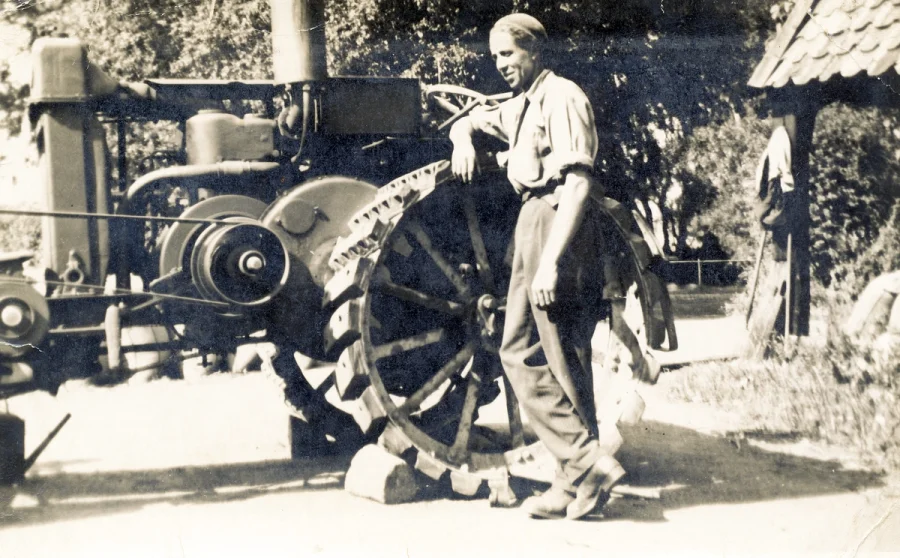
But looking back on that year was the start of some of the sadder parts of when I look back on present day.Our Aveland and Porter Engine, that's the first one that father had and he had it when he was at Bridge Farm, was scrapped. And Freddy Wilson, he worked for scrap iron merchants in Colchester. He came out to the workshop yard and he used the acetylene gas cutting equipment and cut the engine to pieces.
It was a sad day to see them going, and when I looked back now, as I go around the steam shows that we have today and see these engines that have been restored, it does seem a great shame. But there, it's too late now and I'm afraid that's what happened to the other two eventually. The Aveland Porter went first, and then through the years, the Wallace and Stevens went. And then lastly, the Marshall went the same way, all cut up for scrap. I dare say, if the truth is known, some of it went into making guns in Germany and bombs that were slung back at us during the war years. But there, one never knows. There was a lot of our scrap metal was exported to Germany at that time, I remember. Wheelers, the scrap merchants in Colchester, they had a yard at the Hythe and the scrap iron used to be loaded onto the boats there and went across to Germany, but that's international trade and that's how it goes.
The Freddy Wilson that I mentioned that used the cutting gear, he also used to deliver our Sunday papers. He had a pony and trap. He lived in Colchester and worked for the scrap metal trade during the day, during the week. Sundays, he had a pony and trap, and he used to come out from Colchester along the Halstead Road to Great Tey and then back through Marks Tey and back down through Stanway and Lexden, delivering the Sunday papers, News of the World and John Bull, what we used to have. And sometimes mum would buy a comic for us, Playtime, I think it was called. He used to get to us round about middle day of the Sunday, and he used to buy rabbit skins, sixpence a time. Any rags or anything of that sort, he would pay a trifle for, halfpenny or a penny according to what it was. And obviously he turned it over. But that's the sort of life we had in those days. We were happy in our way.
As I said, it was a shame to see the steam engines chopped up, but the weight of them, they averaged between 10 and 12 tons, and the price of scrap iron was only pound a ton, which meant 10 pounds per engine. The only trade to sell them as they were, in working order, was in Ireland. If we could have got them to Ireland for a reasonable figure, we could have made 20 pounds each for them. Just double the price of scrap, but unfortunately it would've cost us more than that extra 10 pounds to get them from here over to Ireland. So that was no point in thinking of doing that.
And, from our own point of view, using them for the thrashing, what with the cost of coal and the labour costs were coming up, it was a case of going over to the tractors to drive the machinery.With them, you didn't have to spend an hour before starting time to get the fire lit. It meant if it was a six o'clock start, which in a good many cases it was on the farms in the summer time. It meant that we'd got to be on the farm by 5:00 AM to get the fire lit in the engine 'cause it'd take an hour to get up steam. And that meant leaving home average about half four so you can imagine that I didn't have too many late nights on account of getting up in time to go out like that. In the winter time, it was dark, it was cold, and the majority of the farms did drop back starting time to half past six, and only having an hour's half hour break instead of an hour as they had been in the summertime, eight o'clock until nine o'clock for breakfast, they cut it back to half an hour and started half an hour later. We then went on till one o'clock, another break until two, for the dinner.
Credit
© Marks Tey Archive
Usage
CC-4.0, view usage statement
Provenance
Polley family
Archive code
MTHP.7.20.1.4