Collections
Item
George Polley's life story (Chapter nine)
Object type
Date
1918-2015
Description
George Polley’s life history, read by George Polley. Chapter nine (4139a), 1944
Highlights in this oral history recording include:
00.00 More on Birch airfield
02.25 Failure of brakes approaching Messing Street
07.45 Ahead of 2nd front Reserved occupations called up. Sunday mornings in the school
10.05 Death of Janet's aunt
11.20 4th June Flying Fortress with bombs crashes between Badcocks and Scotties, Easthorpe
16.09 Alert for Home Guard on 8 June
17.45 Failed attempt to buy house in Marks Tey at Auction – sold £820 – underbidders
19.55 September working at Layer Marney Wick farm – thunderbolt crashes within 50 yards killing John Allen age 19
25.00 Saturday 23 – American Plane comes down at Stanway Hall Farm destroying their machinery
People
Interviewee
George Polley
Place
School Road, Copford
Date
c1999
Transcribed
2026
By
Trevor Leung using AI, corrected by Andrew Waters and Celia Dodd
Transcript
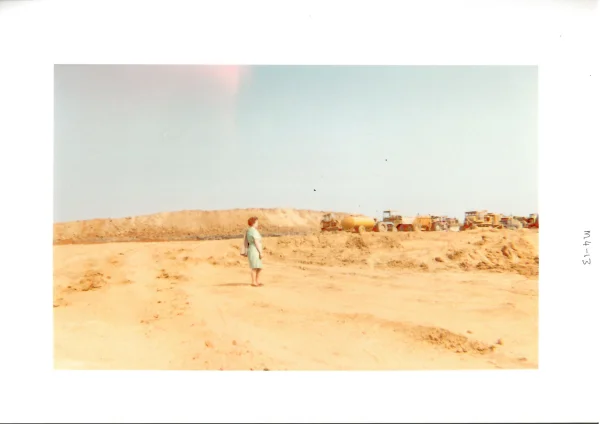
Another page coming up on the life history, GEP. I think this will be page nine. Thinking back at the end of page eight, I think I mentioned about construction work going on by the American forces to Birch airfield. The equipment that was being used, massive earth-moving, concrete-laying equipment for the runways, the earth-moving for the levelling of the various roadways.
It was surprising as a contrast to the equipment that had been used just those few years before to make the Abberton Reservoir. Just no comparison really in the power and the methods of doing the work. It was fascinating beyond all thinking, to see the equipment doing their job. But there, that was so-called progress. The Americans always were ahead of Britain. If they had a job to do, they didn't do it manually like we did in Britain. The Americans made a machine to do the work for them, and they brought it over here when they helped out by making the various airfields throughout the district.
Then a few happenings in 1944. I remember one occasion. I had been moving my tackle, thrashing tackle, from one of the farms in the Layer Marney area. I was coming to Messing Lodge Farm. This meant coming across and down through what is known as Messing Street, coming by Harborough Hall Road, a little bit of a dip, round a bend in the road, and a little bit of a dip just before reaching the Messing Street.
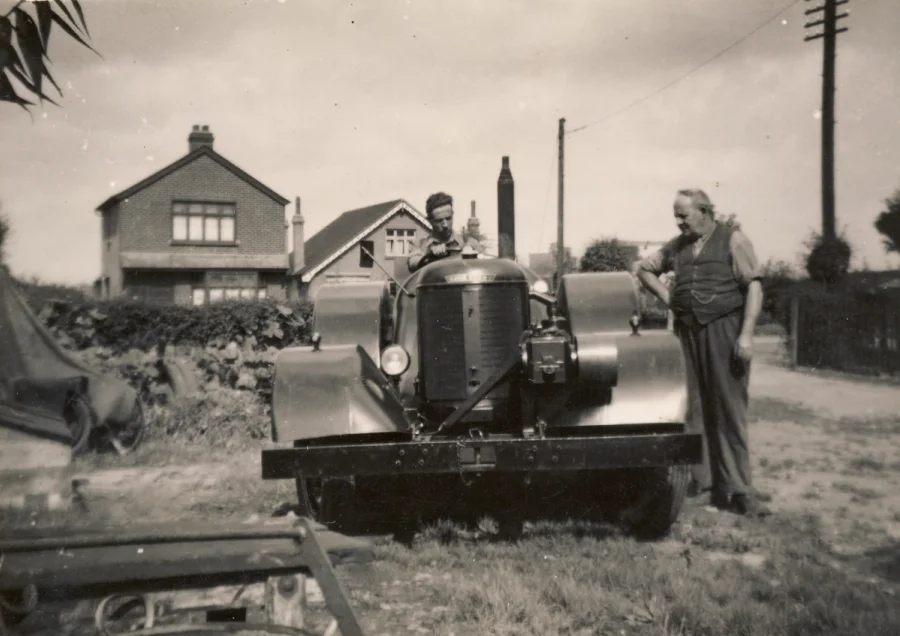
Normally, we came down, just touched the brakes to steady us coming down that slope. This particular day, nothing out of the ordinary. I just dabbed the brake, like being in the habit of doing. Bang! And away I went. The tractors, the Saunderson tractors we used, didn't have any wheel brakes. There was only this one small brake drum operating on the gearbox that I found afterwards had shattered into three different pieces. And a score mark around the inside indicated what we think must have been a small stone had got in the open side of the brake and it wasn't a fabric-lined brake shoe, it was just metal to metal. And presumably, this grit was enough to, more or less, jam and crack the brake drum, then a malleable cast.
It stood a fair load, but in that case it was just too much for it. The lurch that we got, I lost the braking on the actual engine of the tractor, which was only a two cylinder job, and I gathered speed. Luckily there was a grass verge about two foot wide between the tarmac and a shallow ditch beside the road and then the gardens of the houses.
I was able to just hold the line of travel so that I edged the wheels of the drum, which was the heaviest item, onto the grass verge, and it was just enough, soft enough, so that slowed us down and brought us to a standstill. Just yards before that grass strip would've run out and goodness knows what would've happened because I would've gone down the slope into Messing Street. And very narrow and the odd vehicle standing about, I shudder to think what would've happened. But that doesn't matter, we could see what had happened and we thought we've gotta get to Messing Lodge, which was about half a mile down through the street and just up the other side. So, with my mate Joey carrying a wooden block, just to slow things up a bit if it did get out of hand, I got into first gear and the engine just ticking over.
Lo and behold, the grass verge gave way and it made like a little bit of a rack down into the shallow ditch, but I was able to keep moving and eventually got the tackle safely into the farmyard and the stack yard at Messing Lodge Farm. A great relief, I can tell you, to get there after what had happened. But there, that was one of those things, the equipment we had sometimes, looking back on it, it made you wonder that we didn't have more mishaps, but it was all that was available really at that particular time.
Coming round to March of 1944, the general situation was beginning to get a little bit more shown up in the preparations for the second front, and the few of us that were left in the area, that were more or less classified as Home Guard Reserves, we were called into full-time Home Guards. So we had to take on the training, et cetera. The trips to the firing range, using live ammunition with our 303 rifles and what we would've been able to do is very questionable if things had come. But anyway, we had to do our bit, and that meant longer hours because Sunday mornings then were taken up with Home Guard drill, et cetera, and therefore a lot of the Sunday afternoons and the evenings I had to get the servicing of the tackles done, as we did in the busy times.
And yet we were like still looking out for extra equipment, so we went to various machine sales. There was one I recall at Wickham St Paul’s, the thrashing machinery there, the owner had passed away and it was up for grabs, the equipment, but we didn't get anything at that particular sale.
June, the beginning of June of that year, Janet's Auntie Frances was living at Wakes Colne and she was a semi-invalid. Her husband, Janet's father's brother, father Andrew, Frances's husband, he had been chauffeur to titled people up in London and with the war coming on, they had moved out into the countryside and Uncle Andrew and Auntie Frances had got this little cottage at Wakes Colne.
Auntie Frances passed away and we went to the funeral. She was buried at Wakes Colne church yard. If I remember rightly, we had a taxi to take us there with Janet's family, and that was on the Saturday.
On the Sunday, the 4th of June, I was on Home Guard duty and the skies had been full that morning of American flying fortresses. They assembled, they took off from the various airfields around and then circled for a rendezvous on the coast before pushing off on the daylight raids. And this particular Sunday morning, there was one broke away from the flight and crashed on the fields between Badcocks Farm and Scotties Farm, Janet's home, and the wreckage scattered over four fields. A Flying Fortress that's a four engine job, fully loaded with his bombs, the majority of the crew bailed out, but the bombardier was making his bomb load safe and was too late to make his escape.
Unfortunately, he perished in the crash. His remains were found and his identity and that established But the rest of that day, we were at, I went to the farm in Janet's home and the American equivalent of the American Air Force Police, they came and they were hunting around. They put a guard on the wreckage and they were hunting around.
We were hunting because Janet's brother Andrew, was missing. His usual was to walk around the fields, just checking on the position of the various crops, the growth and that. And of course these bombs had dropped. Admittedly, the bombardier had made them safe, so there was no explosions from them, but we were concerned because we couldn't establish where Andrew was.
But it turned, he turned up safe and sound later in the afternoon. He had seen what was happening, realised the bombs and the plane were coming down, so he dropped him down into one of the ditches, bordering the fields, luckily away from where the bombs and the plane actually dropped and he was laying low just in case some of the bombs did delayed action explode, but he was safe and sound and they found the last of the bombs about quarter past 10 that night. Discovered where they were and the actual crash had happened at half past 11 that morning, so of course that was two days before what turned out to be D-Day.
And obviously the heavy amount of American aircraft that were going over on the daylight bombing was to soften up the fortifications et cetera, in preparation for D-Day.
On the 8th of June, Home Guard, we had the alert and I had to join our group. We were on duty that night in Marks Tey school. We were on standby, admittedly. There was an alert had come through, and so we were in Marks Tey school on standby from 22.00 hours to 05.00 the next morning. We learned afterwards that it did coincide with an sort of like some happening similar to what happened at Shingle Street. The, we never knew for certain what it was, but obviously there was a warning from the coastal areas. That hence our call up for standby all night. The, we sort of like carried on with the Home Guard weekends, the visits to the ranges as I mentioned before, and that sort of thing.
In August of that year, as Janet and I had been courting, shall we say, for quite a little while, we'd been engaged for some time. We started house hunting. A house in the village at Marks Tey, the occupants had passed away and the house was on the market. We had a look at it and thought that would be quite useful to us.
It was coming up for auction. We put our price on it, was more or less the limit of what we could muster between us and we thought was a fair price according to house prices at that time. We put a limit on 800 pounds. The bidding was against us at 800. So we ventured another 10, but it went at the next bidding, 820, if I remember rightly. We daren't go any further, so we didn't get it. But we were, we had a go and we thought well our time will come. So, we didn't want to get married until we had got a house. But we decided, well, if it was a case of we couldn't get a house, we would see if we could get one built. So that was what we kept thinking about. Nothing materialised until later.
But in the meantime, still in 1944 in September of that year, I was thrashing down at Layer Wick Farm and there was, we could hear above the noise of the machine, we could hear a couple or three Thunderbolt fighters. They were doing like a bit of dog fight practice overhead, which was reasonably common 'cause we'd got the various fighter aircraft such as Boxted and all around, and Earls Colne, so forth. And it was just commonplace for these fighter aircraft to be doing sort of like dog fight practice, shall we say. All of a sudden realised there was one scream, and looking up, I could see, I was on top of the drum with my mate Jerry.
And looking up, I could just see a black dot with two lines, one either side of the black dot, coming straight for us. I yelled at Jerry to get down. We dropped flat on the top of the drum. And wallop! The aircraft landed just over the hedge, not more than 50 yards from us. I got down off the machine, stopped the tractor and machinery, and everybody, the full team were sort of like upset by what had happened, but we went to where the plane had landed and all we could see was just a heap of clods and flames coming out from between the clods. It being heavy clay soil, and we were just, could see that there was nothing we could do. And one of the workmen that worked on Layer Marney Wick Farm, Jim Fennell, he had his collie dog with him that he used for when they were rounding up the dairy cows for that sort of thing, for milking, we noticed that dog started licking at something and suddenly realised that it was the pilot's scalp, horrible sight. And by the side of his scalp was his identity necklace disc, which gave us his name as John Allen, 19 years of age, USAAF. Oh, it was a terrible sight, but like the good many others that were happening all over the country.
The ambulance came and obviously there was nothing they could do apart from just the odd small portions of humanity. The Padre, I don't know where he came, one of the military padres came, held a service of commitment over the site and after about a couple hours, I think we had pulled ourselves together enough so that we got on with the job. There was nothing we could do, that had happened, and that sort of thing. That was a close shave we felt. But work had to go on. Life had to go on. It had finished for John Allen. But there, I sometimes felt that I would like to have known his parents to let them know that he couldn't have suffered because he must have blacked out and he couldn't have known anything at the last.
Later on at September, it was the 23rd of September, if I remember rightly one of our tackles was set at four stacks of corn at Stanway Hall Farm in the field that is opposite what is now the Colchester Zoo. And that was the Saturday. That Saturday afternoon, I had taken a load of TVO and petrol, lubricating oils, et cetera, and re-stocked the fuel trailer for that particular tackle that my uncle was using at that time. Obviously it wasn't gonna be, they hadn't been working after lunchtime on the Saturday, but the Tempest aircraft at after 10 o'clock had been taken off, because the doodle bugs were reported on their way in, and the Tempest was the only aircraft we'd got at that time that was fast enough to catch up and keep up with the doodle bugs. And somehow or another we did learn the facts afterwards about it, and the engine of the Tempest cut out and the pilot, he bailed out and the plane came down immediately behind our tackle. Of course he was fully loaded with fuel. He'd only just come up from the Bradwell airstrip, and therefore was fully loaded with fuel.
As I say, he crash landed, the fuel went everywhere. The stacks were alight, they were burnt out. Our tackle was burnt out all bar the tractor. Just as it more or less happened there happened to be a truckload of American servicemen on their way into Colchester from the Birch Airfield that was being built. They went in with their six wheel drive tractor lorry, and they hitched onto the back of the tractor. The front of it was alight, but they managed to haul it clear enough and put the flames out on the front of the tractor. So that was, it was saveable, but only from the point of view of their quick action, was it saved.
We got a call. I was called out to take Dad. This was at midnight that night to take Dad along to see the what had happened and just nothing we could do. The fire brigade obviously were there trying to dampen down everything as far as our machinery was concerned. The field trailer was hauled away by the American servicemen. Otherwise, that would've been another inflammable point. But that was all that was salvaged from it.
I went back again the Sunday morning and retrieved the load of flammable stuff from in the fuel bowser trailer and brought it back to our base at Marks Tey. It was just one of those things that excused me from HG (Home Guard) duty that particular Sunday morning. But that was excusable I suppose, under the circumstances. I had to report why I hadn't reported for duty, but there, that the excuse was accepted.
We had to hunt around to find ourselves a replacement machine. We'd always understood from the Agricultural War Committee, that if we lost any of our machinery, all we'd got to do was apply to them and we could draw a replacement from their machinery pool. We did, but they told us there was nothing available, so we had to look around.
We discovered that there was a Marshall oil(?) steel(?) drum. It was for sale by the London Co-operative Society, and that was at a farm in Ongar. We were able to buy it, and the Saturday after the weekend when we lost the, the Youngs drum, in that fire, I went with one of our ????
Credit
© Marks Tey Archive
Usage
CC-4.0, view usage statement
Provenance
Polley family
Archive code
MTHP.7.20.1.9