Collections
Item
George Polley's life story (Chapter two)
Object type
Date
1918-2015
Description
George Polley’s life history, read by George Polley. Chapter two (4135B)
Highlights in this oral history recording include:
0.00 Continuation steam wagon
0.40 Problem of chestnut tree planted outside Bridge Farm
4.50 Early days – work by father in London
8.55 Ford Model T truck, incident 1928 and motorbike
15.00 School clothing club
18.24 Joined Church choir
19.30 School winners of Music Festival at Chelmsford
21.30 Making builders’ ladders
24.00 Thurston Fairs and sports on Rectory Meadow
25.30 Move to Stanway School, At 14 1st prize at Essex Show with lectern for Stanway Church
30.25 Made needlework box for mother
People
Interviewee
George Polley
Place
School Road, Copford
Date
c1999
Transcribed
2026
By
Trevor Leung using AI, corrected by Andrew Waters and Celia Dodd
Transcript
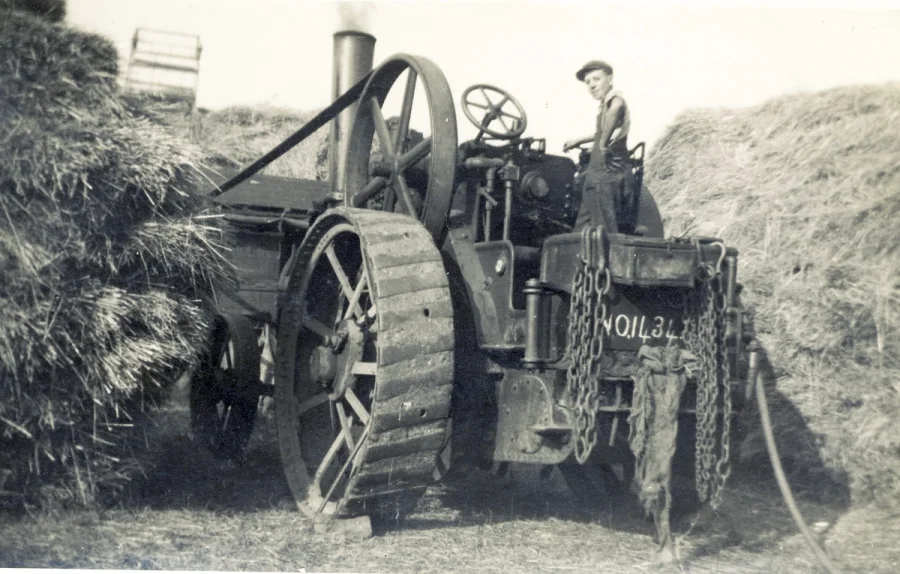
The cab of the old steam wagon was used to form the roof and one end of the bed of the pigs court from Mum, she used to keep pigs and so the wagon cab was made use of like that.
Another point of history in the case of it must have been the coronation of King George the 5th after King Edward 7th died. Around about 1910, the Parish Council Marks Tey decided that they would plant chestnut trees to commemorate the coronation. They planted, there was one on the side of the London Road near Windscroft, that's the eastern boundary of Marks Tey, and another one went in the triangle that was at the end of then Station Road against the Prince of Wales.
Another one went at the roadside opposite The Red Lion on the Coggeshall Road. Another one I remember and still stands today between the two carriageways, near what we know as Dobbies Lane on the main London Road. Another one not far from the blacksmith shop that was on the London Road and on the Coggeshall Road there was one just outside the farmyard gate of Bridge Farm.
Apparently when it was planted, father complained to the Parish Council about the position of it because going in and out with the thrash and tackle, it was a case of you wanted space, especially on a corner. So he said if that could be planted, another 10 foot or so either side of the gateway, it would be much better.
But of course, the Parish Council, they're not usually people to be told what to do. And, so of course one day when father was coming out of the yard with the tackle, he caught the tree and split it. The Council took him to court and he was fined for knocking the tree down. He complained and said that he'd told the Parish Council that it was in the wrong place, but they took no notice, so he couldn't help the damage. At the court, Colchester Court, they found him guilty and fined him, but of course he refused to pay the fine, so they put him in the cells and grandfather had to go down and bail him out, pay the fine to get him out. I don't think mother thought too kindly to that because she was at home at the time with that would be my oldest sister. May would be quite small then.
And obviously even though he felt he was in the right, the Parish Council thought they were in the right too, that the tree survived for not very long, and it wasn't replanted, so indirectly they admitted that it was in the wrong place.
I used to like hearing the tales of what happened in the earlier days. And many’s the time I've been told when it was a slack time on the farm father used to go up to London driving the steam wagons for a firm, EW Rudd, haulage people in London. And he'd be driving steam wagon from the docks, Victoria and Albert Docks in London to the Bermondsey cold meat stores with loads of frozen meat that come in from presumably Australia, New Zealand, or wherever.
And he was going on one of his journeys there. And in those days the trams were running in the streets of London and the radius rod on the steam wagon came undone at the front end. The radius rod being like a stabiliser bar to support the back axle of the wagon. And it came undone at the front end of the chassis and dropped down, and the end of it wedged into the tram line. And of course, with him travelling, it picked the hind wheel of the wagon up in the air. And there it stuck. And so they were holding up all the traffic until they could get another wagon to pull him backwards to release it out of the tram lines. That was one of the episodes of his younger days.
And another time he was used to be relief driving for WH Collier the brickworks at Marks Tey. They had a five or six Fowler traction engines, road engines, and they used to take two trailer loads of bricks behind them. And that's how haulage was done in those days. And he used to drive one of the wagons, but not the wagons, the traction engines with the tow and the two wagons behind, and helped to take a lot of the bricks that built the Severalls Hospital at Mile End in Colchester from there.
And also at that time, the brick wall around Braxted Park was being built and a lot of the bricks were taken from Collier's brickyard to that job. And so father he had sort of quite like a varied young working time, that would be up to the start of the World War. And then of course in 1916 he joined up and was in the army till the end of the war, like my aunt.
When our steam wagon was scrapped, it was replaced with a left hand drive Ford Model T one ton truck. It was bought from second hand from Willetts, the Ford main agents who had a garage sales room where the present William’s and Griffin's showroom in High Street, Colchester. It had been previously used by and owned by A S Bullock, Coal Merchants, in Colchester, and obviously it had been traded in for a newer vehicle.
Being left hand drive it was a little bit awkward on the road from the driving point of view, but all the same it did a lot of work for us. And it had solid rear tyres, solid rubber rear tyres. The fronts were pneumatic. The engine ignition was by what was known as trembler coil at that time. Very, very finicky and temperamental. And many’s the time if it wouldn't start in the mornings, we'd take the sparking plugs out, take them indoors and put them in the oven to heat ‘em through and dry 'em out. And then we'd crank the handle again because there was no such things as self-starters, in those days, not on those Model T's.
And I remember on my 10th birthday, that would be 24th June 1928, I was going for a ride. Obviously I was on holiday from school. My uncle was driving the lorry and we were taking a load of builder’s materials to a building job between Kelvedon and Witham. When we went up through Kelvedon High Stree the big end went, so it was bang, bang, bang. We eventually managed to get it into the Sun petroleum yard in the, up near the top end of Kelvedon, just before we get to where the Convent is, and pulled it in there, got in touch with father at home, and he came along on a Connaught motorcycle. It was a V Belt drive motorbike and, and he couldn't do anything with the lorry then until he got new big end bearings for it. So that meant that I was going to ride back to Marks Tey on the back of the motorbike, that being between four and five miles and no cushion, just a tubular frame to sit on. My bottom was getting a little bit tender by the time we got home, so I had an extra present for my 10th birthday.
The bearings we got, new bearings were got from Willetts, the main agents in Colchester, and father went back and fitted these on. To do this, as they were special size American bolts in the engine he had to get new spanners to do the job, and I still have those, that set of spanners today, after all that time. They're in the workshop here and amongst the rest of my kit. And that's another memory that I had.
The same motorbike mother always used to go in to Colchester every Friday morning to draw the wages from the bank and to get the week’s groceries and shopping and that sort of thing. And this particular weekend they decided father wanted something from Colchester as well, from probably from Martin and Parnell's on North Hill over the engineers’ suppliers shop. And so they decided no one would go on the pinion, so they put a cushion on the back, so it was a little bit more comfortable, and off they set. Of course, they got half a mile down the road and the motorbike refused to go any further. So that was the end of that little episode.
My early school days at Marks Tey School. Not all that exciting, just routine in a way. Facilities were not all that modern as you might as well say, according to today's standards, but as we were living at one end of the village, there was not much in the way of playmates at my end, so I didn't really have any so-called playmates at school.
I was never very keen on any of the sport, what little there was going. And I was more keen to get on with my lessons 'cause I, I was interested in especially arithmetic, whether it was because I saw Mum and Dad making out the bills that went out to the customers and that sort of thing and it was an incentive, but that's how it, how it went.
Mother, to help make ends meet, she used to go as domestic help two mornings a week at Marks Tey Hall. And when it was, she used to come along about playtime in the mid-morning session and on Monday mornings she would give me, as I was in the playground, she would give me a sixpence. And after school at 12 o'clock, I'd got to take the sixpence round to the Rectory because the Rector ran what was known as the clothing club. And it was run for 50 weeks in the year and sixpence a week for 50 weeks it was quite a colossal sum come the end of the year. It was worth a lot. And so that was one little job I used to have on a Monday lunch break before I could eat my sandwiches, which mother packed for me on the mornings that she went out. Otherwise, I used to walk back home again, because school finished at 12 o'clock and didn't start again until half past one. So that I had to go home usually for my lunch.
By the time I was up to about 10 years old, the Rector suggested would I like to join the church choir? So of course, mother backed me up because she thought that would be alright. And I had to go and the Rector he, the Canon Steele he was at that time, he had his tuning fork and he donged that and I had to hum the tune that the tuning fork came out. And then he would play a note on the piano and I had to hum that. Obviously I passed the test because I joined the choir. And I was in the church choir right up until I was 14 and left school. By that time I'd seen a little of the outside world and decided that everything on the surface, which appeared to be okay, when you looked underneath a little bit, it was far from being okay, but that was beside the point.
Back to the school there used to be an annual Music Festival at Chelmsford Cathedral and the school, Mrs. Ball, the teacher in the middle room, she was the music teacher and she used to have the choir from the school, the whole school. And I went with the choir two separate years. And for the Music Festival in Chelmsford Cathedral, one year when I went, we got the banner for the best choir, and that was quite a usual attainment for the Marks Tey school choir to get the banner. Whether I was singing out of tune the time that we didn't get it, I don't know, but they had to share it around, I suppose, a little bit. We couldn't expect to get it every year and but that was an occasion to work to.
When I was spare time from school, I used to, instead of going on to the playing field and that sort of thing, well it was the Rectory meadow it was, it wasn't really a playing field, it was just courtesy of from the Rector, because the field belonged to the Rectory. And the school were allowed to, on certain occasions, to use it as a playing field and the local village football team used to play there. But we I used to spend a lot of my time in the workshop at home because there was always something going on in the way of machine repair, various things, filling in time for the workmen. We used to buy, father used to buy tree tops from the timber farms that came to the area and, and bought the tree trunks. And so we built up quite a bit of firewood trade.
Also they used to get the builders - always wanted ladders, good, strong, long ladders. That was another sideline we had, and we used to get the, what was known as a scaffold pole, that was a fir pole, from Groom and Daniels, the timber merchants in Colchester, and they would saw them, the whole length of them in two in halves. So it made the two, what we call the balks(?) of the ladder. And then for the rungs, Dad used to buy up old pony carts and the timber spokes in the wheels were ideal for making the rungs because they were usually ash and good solid wood. And I used to help sometimes by shaping these up and the holes through the balks(?) had to be drilled and reneed(?) to taper to take the rungs after we'd rounded the ends and cut them all to the given size. They had to be so much longer for the bottom end of the ladder, and it gradually narrowed off to the top end. But we used to supply nearly all the local builders with the ladders that we made.
Village affairs every year. We used to have the Thurston’s Fair, came onto the Rectory Meadow and there would be the parish fete, sports and that sort of thing, fancy dress. One year mother made me some overalls and my grandfather, mother's father, he was signalman at Marks Tey on the railway, and we had one of his old peak caps and padded it round the inside so that it would stay on my head. So I went in for the fancy dress with a pipe in my mouth and a false moustache clipped into my nose, an oil can in one hand and a spanner in the other. And I went in the fancy dress as an engine driver. Course I took first prize and that was a deluxe model of a torch and I still have that torch today, and it's still in good working order. That's one of my proudest pieces of memory on that. But of course when the law was changed and at 11 we had to pass our exams and then go to what was termed a higher school.
This happened to be at Stanway then, and we were taken in a bus and that was where I did the rest of my school days. I was pretty keen on the carpentry from always being messing around in the workshop at home. And I was chosen to work on the wood-carving side of things, and the idea came up, the woodwork master came up, that I was good enough to make a reading desk or a church lectern as it was called. And there was the carving on it. That was made and as far as I know it is still in St. Albrights Church, Stanway. There was carving on the front - Heaven's light, our guide, there was animals, a squirrel carved into one side under the head, flowers the other side and a bird on it, and quite a lot of work went into it and it was entered into the local show at Lexden and took first prize there.
I was photographed with Sir Oswald Lewis. He presented me with a cup. I was also presented to the Mayor and Mayoress of Colchester and Mr and Mrs Hazel, and that was when I was 14. I. The Essex Show of that year was held at Rochford near Southend, and it was entered, the lectern was entered in the County Show under the school section, and there it took the Challenge Cup, more photographs. To get there I had an aunt, Dad's sister lived in Southend, so I cycled from Marks Tey to Southend, and I had a week there at the time the show was on. And then I cycled back again at the end of the week. Of course, in those days, one was reasonably safe cycling on the road because there just wasn't the traffic and I had the credit of making it but I must say that I had school pal of mine at Stanway - Rex Dudley. He did help with a lot of the work and the joinery side but he didn't get the publicity that I did. I've still got the cuttings, photographs and so forth of it. Our woodwork master was a Mr. Edgar and they naturally wanted me to go into the firm in Colchester that worked on all church carvings, but I was never too happy with the woodwork. I could do it, but the steam engines had a bigger pull, and so instead of going on to the wood carving, the, the job that was offered to me was taken up by Leonard Ratcliffe, who was also a good wood carver at the same time, leaving school the same time that I did, and he made a career of it and very successful at that. But I was happy to go with my family business, and that was to be, I suppose, and I'll think of some more another time.
The only other thing that I made at my woodwork classes was a needlework box I made for mother; and it had her initials, FEP, carved onto the front of it and that box now, if I remember rightly, my daughter Linda has as one of her treasures 'cause it's the something in the family’ as the saying is, which it was made in satin walnut wood, and took quite a bit of work.
Credit
© Marks Tey Archive
Usage
CC-4.0, view usage statement
Provenance
Polley family
Archive code
MTHP.7.20.1.2